Table of Contents
ToggleYour entryway is the first thing you, and guests, see when entering your home. It’s also where chaos tends to accumulate: shoes pile up, coats drape over chairs, keys vanish into thin air, and mail stacks up on the closest surface. The good news? A well-organized entryway doesn’t require a major renovation or a big budget. By implementing practical storage solutions and smart systems, you can transform this transition zone from a cluttered catch-all into a functional, welcoming space. These entryway organization ideas work for apartments, small homes, and sprawling houses alike. Let’s walk through seven actionable strategies that’ll make your arrivals and departures smoother.
Key Takeaways
- Assess your entryway’s current layout, pain points, and architectural constraints before buying storage solutions to ensure your organization system actually solves your specific problems.
- Install dedicated shoe storage—such as benches with built-in cubbies, shoe cabinets, or over-the-door organizers—to eliminate scattered pairs and reclaim floor space.
- Create a coat and accessory hub using heavy-duty hooks anchored to wall studs and add floating shelves for hats and accessories to keep seasonal items within arm’s reach of the door.
- Set up a mail and key management station with wall-mounted key racks, vertical mail organizers, and a phone charging nook to prevent critical transition items from scattering throughout your home.
- Maximize vertical space with shelving, floating shelves, and strategically spaced hooks at varying heights to multiply entryway organization storage without consuming floor space.
- Focus on creating a functional system that matches your household’s lifestyle rather than pursuing perfection—start with one section and build momentum from there.
Assess Your Current Entryway Layout and Pain Points
Before you buy a single hook or shelf, take a hard look at what’s actually broken about your entryway right now. Walk through your door like a guest would. Where do shoes end up? Where do family members dump bags, jackets, and accessories? What gets lost most often, keys, sunglasses, wallet?
Measure your entryway: width, depth, ceiling height, and available wall space. Note any architectural quirks, a narrow hallway, a low soffit, or an awkward corner. Identify traffic patterns: do people naturally veer left or right when entering? Is there a bottleneck near the door?
Understanding your specific pain points and physical constraints ensures that whatever solutions you install actually solve your problem instead of adding more clutter. A bench with shoe storage looks great in a magazine, but it’s useless if your entryway is only 3 feet wide. This assessment phase takes ten minutes but saves countless hours of frustration later.
Install Functional Shoe Storage Solutions
Shoes are often the biggest culprit in entryway chaos. Scattered pairs pile up, making the space look messy and making it hard to find a matching set when you’re running late.
Consider these options:
- Shoe racks or cubbies: Open-design metal or wooden racks hold 10–20 pairs and keep shoes visible and accessible. Best for dry climates: wet shoes may drip onto flooring.
- Shoe cabinets with doors: Enclosed cabinets hide clutter and contain moisture. Standard widths are 24–36 inches: depth varies from 12–18 inches.
- Over-the-door shoe organizers: Fabric or plastic pocket systems maximize vertical space in tight areas. Capacity is 10–16 pairs per door.
- Pull-out drawers or shelves: Built-in solutions under a bench or console (see below). Drawers contain moisture and debris: typically hold 8–12 pairs depending on depth.
Bench With Built-In Shoe Storage
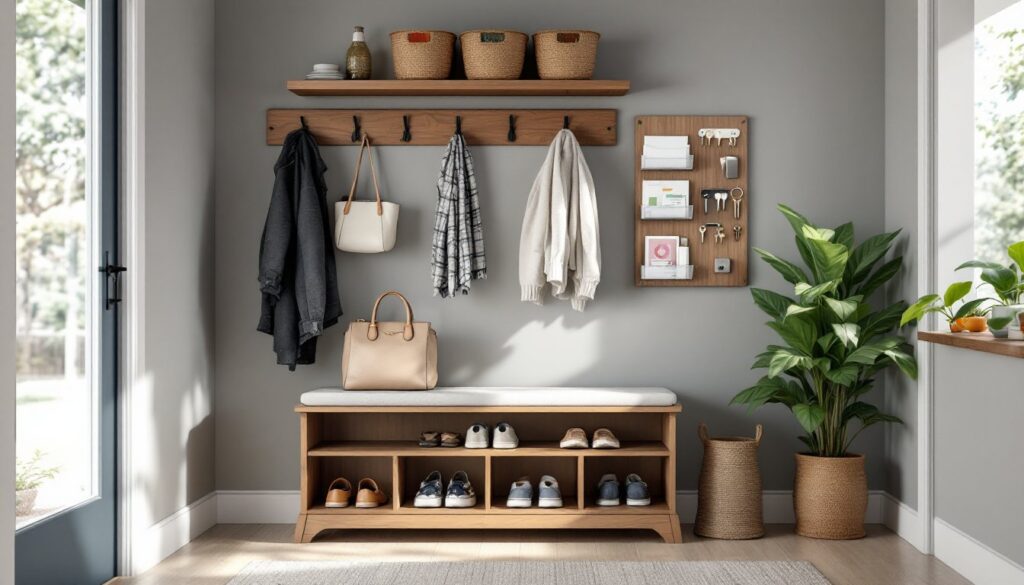
A shoe storage bench is one of the most practical and attractive options because it combines seating (for putting on shoes) with storage. You can buy a finished bench ($150–$400) or build one from scratch.
Basic dimensions: A 36–48 inch wide bench with a 12–15 inch deep base and 16–18 inch seat height accommodates most bodies and doorways comfortably.
Building one: Use pressure-treated 2×4 lumber for the frame, secure with 2.5-inch wood screws or bolts. Add a plywood platform (nominal 3/4-inch thickness, which is actually 0.75 inches), then open cubbies or pull-out drawers below using 1×12 or 1×10 boards. Finish with sanding (120–150 grit) and two coats of polyurethane or exterior-grade paint if the bench sits near a door. Seal or prime end grain to prevent swelling from humidity.
Create a Coat and Accessory Hub
Coats, scarves, hats, and bags need a dedicated home, or they’ll migrate into the bedroom, living room, and car. A coat and accessory hub keeps seasonal items within arm’s reach of the door.
Hook placement and styles:
- Standard wall hooks (3–5 inches deep) hold one coat and a scarf. Space them 12–16 inches apart horizontally and 60–72 inches high (child-accessible heights around 48–54 inches).
- Heavy-duty hooks rated for 10–15 pounds per hook handle winter coats and bags without bending or pulling out.
- Rail systems (a horizontal rod with evenly spaced hooks) distribute weight across studs and can hold 8–12 coats depending on length.
Installation: Locate studs using a stud finder and anchor hooks directly into studs with 2.5-inch wood screws (for wood-frame walls) or lag bolts (for masonry). Drywall anchors alone won’t reliably hold multiple coats: they’re rated for 5–10 pounds and fail under repeated stress.
Bonus storage: Add a narrow floating shelf (6–8 inches deep, 24–36 inches wide) above the hooks for hats, gloves, and sunglasses. Keep decorative baskets on the shelf for small accessories, mittens, scarves, dog leashes. Kids Closet Organization Ideas: offers techniques for involving family members in keeping this zone tidy.
Add a Mail and Key Management Station
Mail piles up. Keys vanish. Phone chargers get buried. A dedicated mail and key station prevents these items from scattering across your entryway and home.
Key holders: Wall-mounted key racks come in many styles, hooks, magnetic strips, or small shelves with hooks. Magnetic strips ($15–$30) work well for houses with metal key heads: hooks suit any key type. Mount one at eye level (60–66 inches high) near the door for grab-and-go access.
Mail organizer: Vertical wall-mounted mail holders (wood, metal, or acrylic) sort incoming and outgoing mail, bills, and packages. Opt for at least two slots, “To Open” and “To Action.” Place it at chest height (48–54 inches) next to the key holder.
Charging station: Entryways are perfect for a phone charging nook. Mount a recessed outlet box (in-wall) or use a surface-mounted power strip (rated for 15 amps) with a short charging cable. Keep cords tidy with adhesive clips or a small cable box.
These items address what Home Key Organization: Transform Chaos into Calm with Simple Tips calls the “critical transition items”, keys, mail, and devices that need immediate access but cause clutter if left loose.
Maximize Vertical Space With Shelving and Hooks
Vertical space is often overlooked but is your entryway’s biggest untapped resource. By installing shelving and hooks from floor to ceiling, you multiply storage without consuming floor space.
Shelving options:
- Floating shelves (6–10 inch depth): Anchor to studs with heavy-duty brackets rated for 25–50 pounds per pair. Install at varying heights (60, 48, and 36 inches) for visual interest and function.
- Wall-mounted cabinets: Upper cabinets (12–15 inches deep) store seasonal items, batteries, and frequently forgotten items. Lower open shelves (12–18 inches deep) display decorative baskets for umbrellas or scarves.
- Pegboard systems: Highly flexible and adjustable. Paint or stain pegboard to match your décor: use hooks and baskets to corral small items. Pegboard is lighter weight than shelving but handles about 15–20 pounds per hook.
Hook types and spacing:
- Standard single hooks: 3–5 inch reach, best for lightweight items.
- Double or triple hooks: 6–8 inch reach, handle coats and bags.
- J-hooks: 2–3 inch hook depth, ideal for cords, scarves, or pendant items.
Space hooks 12–16 inches apart. Stagger them at different heights to prevent congestion. When working with renters or temporary arrangements, adhesive strips and command hooks ($1–$3 per hook) offer flexibility, though they’re rated for lighter loads (5–7 pounds per strip).
Inexpensive Home Organization Ideas: Transform Your Space Without Very costly highlights budget-friendly vertical solutions that don’t require permanent installation. DIY Home Organization: Transform walks through building custom shelving units from scratch. And for a deeper organizational framework, Home Organization Checklist: Transform offers a complete audit process.
Conclusion
A transformed entryway starts with understanding your space, identifying pain points, and installing functional solutions tailored to your lifestyle. Whether you’re adding a shoe storage bench, hooks for coats, a mail station, or vertical shelving, each addition should earn its place. Entryway organization isn’t about perfection, it’s about creating a system that works for your household, making daily arrivals and departures smoother and your home’s first impression stronger. Start with one section, build momentum, and enjoy the space you’ve created.